 how-to
How to Choose a Roofing Contractor for Replacement
Table of Contents
- Start with Contractor Credentials and Local Licensing
- Verify Insurance Coverage and Bonding
- Review Experience, Local Knowledge, and References
- Questions to Ask a Roofing Contractor Before Hiring
- How to Compare Roof Replacement Estimates Line by Line
- Use a Roofing Contractor Checklist and Review the Contract
- Review the Roof Replacement Contract Checklist Before Signing
- Red Flags: Storm Chasers and High-Pressure Sales Tactics
- Frequently Asked Questions
Last Updated: October 20, 2026
Start with Contractor Credentials and Local Licensing
Learning how to choose a roofing contractor for replacement starts with verifying credentials.
Check your state's licensing board first. In Washington, the Department of Labor and Industries oversees licensing and lets you verify a contractor's status online.
Local knowledge matters. In the Pacific Northwest, that means experience with wet conditions and moss growth. Sound Roof Care has served the Puget Sound since 2009.
Key steps for vetting credentials:
- Request a copy of the contractor's license
- Verify it's current and in good standing
- Confirm they carry liability insurance
- Check if they're bonded
A bond protects you financially if the contractor abandons the work or causes damage.
Verify Insurance Coverage and Bonding
Insurance and bonding are non-negotiable. A contractor without proper coverage puts your property at risk.
Ask for a certificate of insurance before work starts and call the insurer to verify it's active.
Request a copy of the bond and verify it covers your project cost.
Insurance checklist:
- General liability coverage (at least $1 million)
- Workers' compensation (required in most states)
- Valid certificates of insurance
- Active surety bond matching project cost
A contractor who refuses to show insurance documentation is a red flag. Walk away immediately.
Review Experience, Local Knowledge, and References
Understanding how to choose a roofing contractor for replacement means prioritizing experience with roof replacement in your climate over general roofing work; a repair specialist might lack replacement expertise.
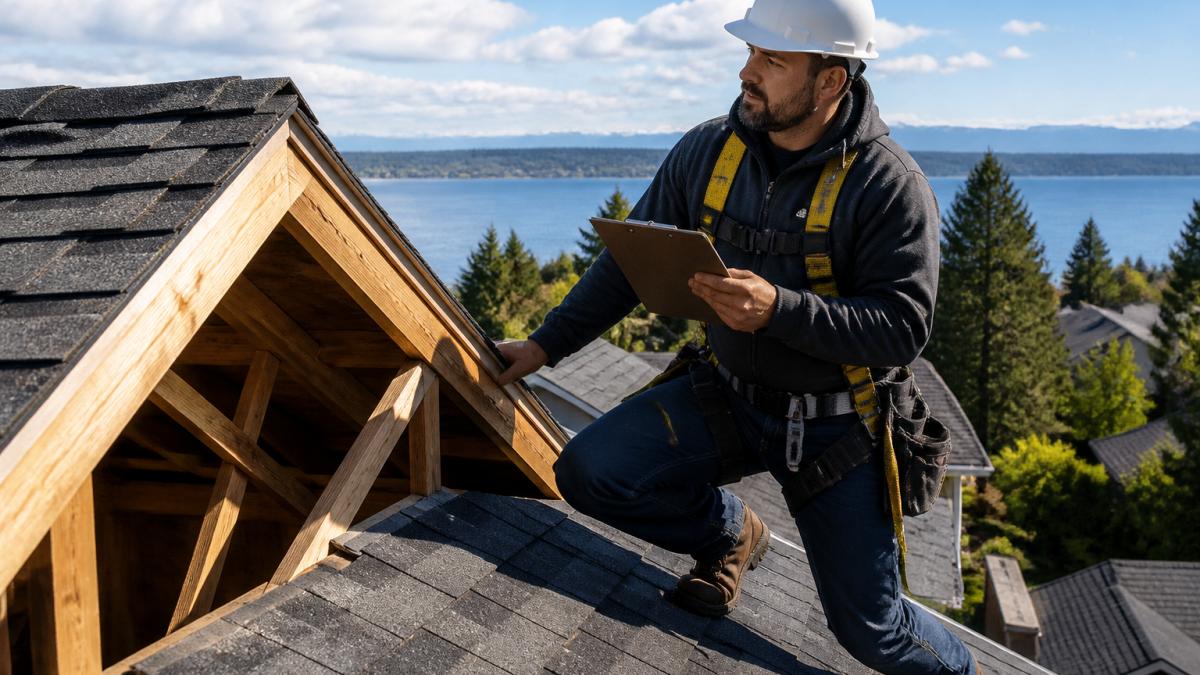
Local knowledge is crucial: a contractor familiar with your area understands seasonal challenges, code variations, and which materials hold up best.
Request references from past customers and call at least three. Ask about communication, timeline adherence, and how they handled unexpected issues.
Check Google, Yelp, and the Better Business Bureau for patterns. One negative review is normal; multiple complaints about the same issue signal a problem.
Questions to ask references:
- Did the contractor finish on schedule?
- Were costs as quoted?
- How did they handle unexpected damage?
- Would you hire them again?
Questions to Ask a Roofing Contractor Before Hiring
The right questions reveal whether a contractor is trustworthy. Start with how they handle unforeseen conditions.
Roof replacement often uncovers hidden damage, water damage, rotted wood, or structural issues, visible only after tear-off.
Ask about cleanup: a professional uses tarps, removes nails, and cleans up daily.
Ask about the warranty. Manufacturer warranties cover material defects. Workmanship warranties cover installation quality.
Ask about payment terms.
Essential questions list:
- How do you handle hidden damage discovered during work?
- What's your communication schedule during the project?
- What's included in your workmanship warranty?
- What's your payment schedule?
- How long will the project take?
- Will you obtain permits?
Ask how they'll protect your landscaping and exterior, roofing work can damage gutters, siding, and plants.
How to Compare Roof Replacement Estimates Line by Line
Multiple estimates let you compare pricing and scope, but the bottom-line number is the least useful part of a bid, two contractors can quote the same total for completely different work. Break each estimate into the same line items to confirm equivalent scope, materials, and risk allocation.
Get at least three written, itemized estimates; a lump-sum bid is hard to compare and easy to inflate through change orders.
Build a line-item comparison sheet
Create a spreadsheet with one column per contractor and one row per scope item. At minimum, include these rows:
- Tear-off and disposal, Is removal of the existing roof included? How many layers are being removed? Is the dumpster or disposal fee a separate line?
- Decking and sheathing, Is any allowance included for replacing rotten or damaged decking? What is the per-sheet price if more is found?
- Underlayment, What product and type (for example, synthetic versus felt), and is it specified by brand?
- Ice and water shield, Which areas receive it (eaves, valleys, penetrations), and how many square feet are priced?
- Flashing, Are step flashing, counterflashing, valley flashing, and pipe boots included, and are they new or reused?
- Ventilation, Are ridge vents, soffit vents, or intake vents included? Is the ventilation calculation shown?
- Roofing material, Manufacturer, product line, profile, color, and warranty tier, not just "architectural shingles."
A blank row is not a saving, it's an undefined cost. Ask the contractor to price it before comparing totals.
Watch for non-equivalent bids
A lower total often reflects smaller scope, not a better price. Common divergences:
- One bid includes tear-off; another proposes a layover over the existing shingles.
- One specifies a synthetic underlayment; another uses a lower-grade felt.
- One includes new flashing; another reuses existing flashing.
- One prices a certain number of decking sheets; another carries no decking allowance at all.
- One includes the permit; another leaves it to the homeowner.
Normalize the bids before comparing: add missing items at the contractor's stated price or request a revised bid. Only then does the total mean anything.
Compare material specifications, not just grades
"30-year shingles" is a warranty label, not a specification. Ask for the manufacturer, product line, and warranty tier in writing, two bids can both say "architectural shingles" while specifying different wind ratings, algae resistance, and warranty terms. The same applies to underlayment, flashing, and ventilation components.
Price the hidden conditions before tear-off
Roof replacement routinely uncovers conditions invisible from the ground: rotted decking, deteriorated flashing, inadequate ventilation, or code upgrades. A bid that ignores these possibilities is not more competitive, it is incomplete.
Ask each contractor how they document and price discoveries after tear-off. A transparent bid typically includes:
- A stated per-sheet price for decking replacement.
- A per-linear-foot price for flashing repairs.
- A written change-order process requiring your approval before extra work proceeds.
- A contingency allowance, or a clear statement that no allowance is included and how overages will be handled.
Compare those unit prices across bids, not just the base total: a slightly higher base bid with fair, pre-agreed unit prices for hidden damage may be safer than a low base bid with open-ended change orders.
Ask each contractor to submit the bid on the same line-item template. When every bid uses the same rows, missing scope and inflated unit prices become obvious at a glance.
Sanity-check the outliers
If one estimate is far below the others, ask why in writing: common explanations include smaller scope, lower-grade materials, no decking allowance, excluded permits, or a crew paid by the square with incentives to move fast. A bid far above the others may include unrequested upgrades or a different scope. Either way, the line-item sheet tells you which.
The lowest total is not the lowest price until every bid covers the same scope. Compare line by line, price the hidden conditions, and only then compare totals.
Use a Roofing Contractor Checklist and Review the Contract
A written contract protects both you and the contractor and is your main defense against payment disputes, scope creep, and liens. Never start work without one, and never sign one you haven't read line by line.
Scope and specifications
The contract should specify the scope of work in detail: what is included and excluded, whether underlayment is replaced, whether flashing is new or reused, and whether gutters, skylights, or satellite dishes are removed and reinstalled. List materials by manufacturer, product line, and color so substitutions cannot happen quietly.
Price, payment schedule, and deposits
The contract should state the total price and break it into a payment schedule tied to milestones, not dates: a modest deposit, a progress payment after tear-off and dry-in, and the balance after final inspection and cleanup.
Never pay the full contract price before the work is complete. A large upfront payment removes your leverage if the crew stops showing up or the work fails inspection.
Ask what the deposit covers and whether it is held in a separate account. Confirm in writing when the final payment is due, ideally after you have walked the roof, confirmed cleanup, and received the warranty documents.
Lien waivers and proof of payment
A roofing contractor who does not pay suppliers or subcontractors can leave you exposed to a mechanic's lien, even after you have paid in full. Protect yourself by requiring lien waivers as part of the payment process:
- Ask for a conditional lien waiver from the contractor and major suppliers each time you make a payment; it becomes effective when the payment clears.
- Ask for an unconditional lien waiver at final payment, confirming all labor and materials have been paid.
- Keep copies of every waiver with your contract and payment records.
Change orders and hidden conditions
Roof replacement often uncovers damage not visible before tear-off. The contract should require written approval before any additional work proceeds, with the added scope and price stated in a signed change order. Verbal approvals are difficult to prove and easy to dispute.
Cancellation and dispute terms
The contract should state your cancellation rights, including any cooling-off period your state provides for home-improvement contracts, and describe how disputes are handled, for example, whether the contractor agrees to mediation or arbitration before litigation, and which state's law governs the agreement.
Insurance, licensing, and warranty in writing
Confirm the contract lists the contractor's license number, insurance coverage, and bonding information, and that it matches what you verified independently. The warranty section should separate the manufacturer's material warranty from the contractor's workmanship warranty, with years and exclusions stated for each.
Contract essentials checklist:
- Detailed scope of work with inclusions and exclusions
- Materials listed by manufacturer, product line, and color
- Total price and milestone-based payment schedule
- Deposit amount and what it covers
- Conditional and unconditional lien waiver requirements
- Written change-order process for hidden damage
- Start and completion dates, with weather-delay terms
A strong roof replacement contract ties payments to milestones, requires lien waivers, and puts every change in writing. If any of those pieces is missing, ask for it before you sign.
Review the Roof Replacement Contract Checklist Before Signing
Before signing, verify every detail matches your agreement.
Check the contractor's name and business license number.
Verify the total price matches the estimate.
Confirm the start date and expected completion date.
Verify material specifications match what you discussed.
Check the warranty section. Manufacturer warranties are standard.
Confirm the payment schedule.
Ask about insurance again.
Pre-signing checklist:
- Contractor name and license number match verification
- Project address is correct
- Total price matches estimate
- Material specifications are exact
- Warranty terms are clear
- Payment schedule is defined
- Insurance information is listed
- Change order process is explained
Don't sign if something feels off.
Red Flags: Storm Chasers and High-Pressure Sales Tactics
Storm chasers are contractors who appear after severe weather, offering quick roof replacement deals.
Avoid contractors who approach you unsolicited after storms. Legitimate contractors don't need to chase business.
Avoid contractors who guarantee insurance will pay for the full replacement.
Red flag warning signs:
- Unsolicited contact after storms
- Pressure to sign immediately
- Guarantees about insurance coverage
- Out-of-state license plates
- No local office or phone number
- Reluctance to provide references
- Verbal promises not in writing
A trustworthy contractor like Sound Roof Care builds relationships through honest service.
Choosing a roofing contractor for replacement is one of the biggest home maintenance decisions you'll make.
Frequently Asked Questions
What questions should I ask a roofing contractor before hiring?
Ask about their contractor license, insurance coverage, local experience, warranty terms, project timeline, payment schedule, and how they handle unforeseen issues like hidden damage. Request references from recent roof replacement projects and ask how they manage building permits and local building codes. Clarify whether they'll provide a written estimate and contract, and ask about their communication process during the project.
How do I compare roofing contractor bids for a roof replacement?
Request written estimates from at least three contractors that itemize roofing materials, labor costs, permits, cleanup, and warranty terms. Ensure estimates use the same roof system specifications and quality standards for fair comparison. Watch for unusually low bids, which may indicate corner-cutting or hidden costs later. Compare the contractor's experience, local knowledge, and workmanship warranty alongside price rather than choosing based on cost alone.
What red flags should I watch for when hiring a roofing contractor?
Avoid contractors who pressure you into immediate decisions, demand full payment upfront, lack verifiable licensing or insurance, or appear after storms offering unsolicited sales. Be cautious of those who won't provide written estimates or contracts, promise unrealistic warranties, or discourage you from getting multiple bids. Verify they're established locally and have genuine customer references, not just high-pressure storm-chaser tactics.
What should a roof replacement contract include?
A written contract must specify the roofing materials, installation scope, project timeline, payment schedule with holdback provisions, warranty terms for both materials and workmanship, how change orders are handled, cleanup expectations, and permit responsibilities. Include details on safety practices and quality control measures. Ensure it addresses unforeseen issues discovered during removal and clarifies the contractor's liability insurance coverage. Never sign without a complete, itemized contract.